
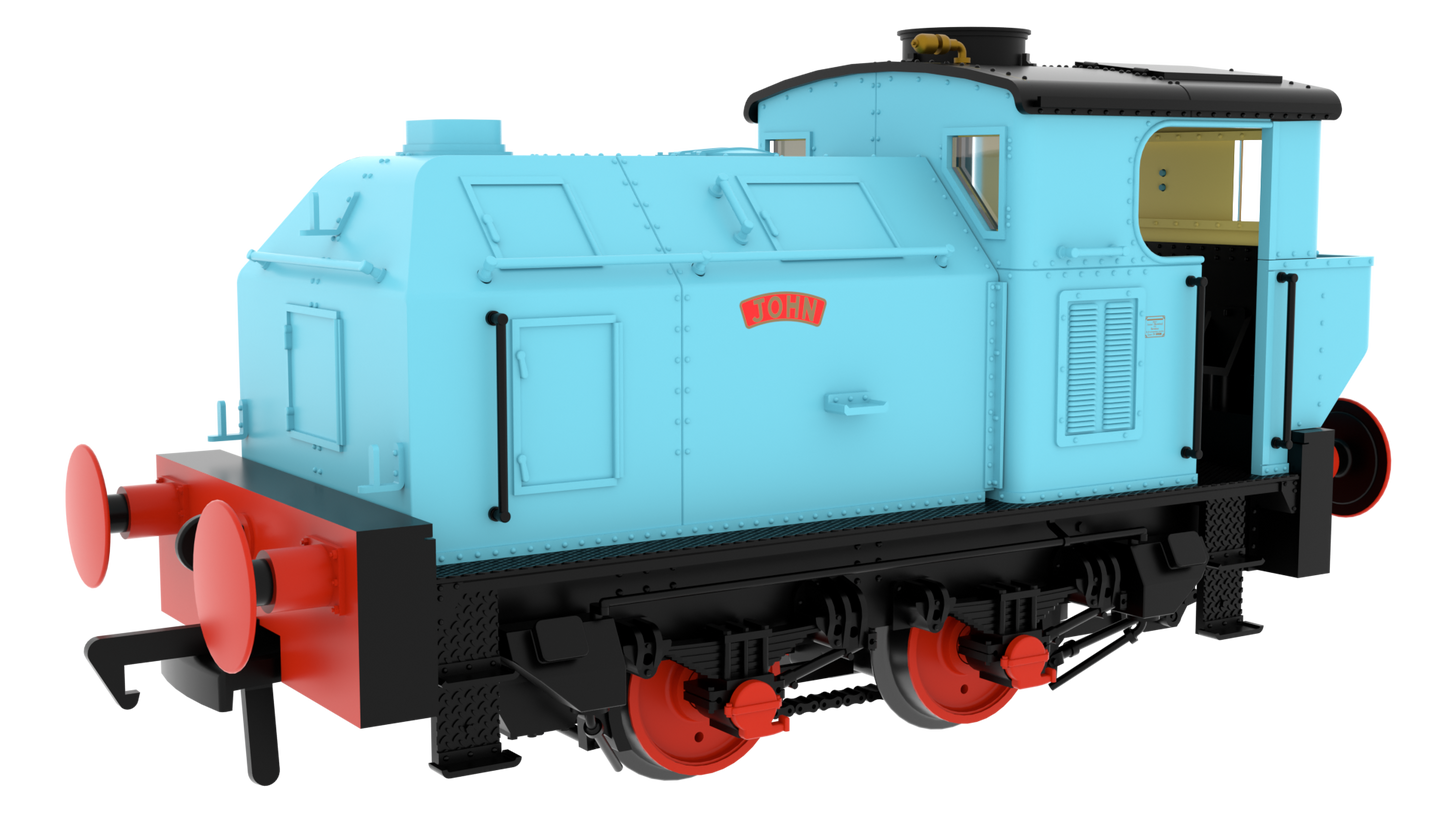
Rapido Trains UK 949201 Post-War Sentinel - RB Tennents 'John' Steam Locomotive

- Pre-Order
Product Details
| SKU | RAP-949201 |
|---|---|
| Vendor | Rapido Trains UK |
| Categories | Best selling products Era 5 Era 6 Era 7 Free Postage HO-OO Locomotives New products OO Gauge Locomotives OO Gauge scale OO Gauge Steam Locomotives Pre-Orders Rapido Trains UK Rapido Trains UK Sentinel Steam Shunters Steam Locomotives |
| Scale | OO Gauge |
| Share | |
| Features |
|
Product Description
- Blue with red details
- Closed cab back sheet with bunker
- Wide chimney
- Low-mounted sandboxes
- Rear-mounted radius rods
- 24-inch buffer heads
- 4 footsteps
- E24 DCC decoder socket
- Factory-fitted speaker
- Museum quality paint finish
- MoPower stay-alive
- Diecast metal and plastic construction
- Smooth & powerful mechanism
- Highly detailed
- NEM 362 coupler pockets front and rear
- 1:76 scale, (OO gauge)
Unlike the majority of industrial railway locomotives, the Sentinel steam shunter concept evolved from road vehicle technology rather than other railway loco designs.
Founded in 1875, Alley & MacLellan Ltd of Polmadie, Glasgow was the original trading name of what would become the Sentinel Waggon Works Ltd. This is where the roots of the Sentinel steam shunter prototype would come from.
In 1906, the company introduced its first vertical-boiler steam road waggon. This powered the wheels via a two-cylinder undertype engine and chain drive. Very reminiscent of the internal combustion engine designs that would follow, only powered by steam instead. They proved incredibly efficient and incredibly straightforward to fire and drive.
Around twenty years later, the Sentinel Waggon Works applied the same idea to its first 0-4-0 railway locomotive prototype.
Even in their earliest guises, they were well regarded by crews and businesses. Thanks to their short wheelbase, they were capable of negotiating the tighter radius of many industrial networks. When combined with their fast steam raising ability (under an hour), fantastic fuel economy and operational simplicity, they were a hit with crews and business owners alike.
The steam Sentinel would be built in a range of diverse styles, with the main two-cylinder vertical engine, known as the ‘BE’, being the most commonly produced before WW2. An example of the ‘BE’ was even built for the LMS. In the post-war years, different body types were produced and in greater numbers than their predecessors.
To the untrained eye, the ‘BE’ looks much like a domeless locomotive. However, on closer inspection you discover that in place of the chimney, the ‘BE’ has its vertical cylinders hidden by a round cover. This protrudes from the top of the loco's body at the front.
In place of what we would usually think of as a loco's boiler is a substantial water tank. Not only does this huge tank mean that the Sentinel could run for a prolonged period of time before filling up, but it also added considerable weight, which improved the adhesion of the loco.
Following World War Two, an improved design was produced. The tank and cylinders were also clad in a metal casing. These included access hatches so that repairs and servicing could be carried out.
Production of the Sentinel steam shunter continued right through until 1958. Though the end of an era for industrial railways, this was only part of the Steam shunter's story. The Sentinel would go on to adopt the internal combustion engine as its motive power, and its legacy would be continued by Rolls-Royce through the production of various Sentinel diesel locomotives. Whilst production may have finished in 1958 – many locomotives continued in industry for several decades.
Unlike most industrial prototypes, the preservation movement was very kind to the Sentinel steam shunter. Surviving examples can be found the length and breadth of the country at many preserved railways – with several in working order.
The Rapido Trains UK highly detailed OO Gauge Sentinel Steam Shunter 0-4-0 is available in both Pre-War and Post-War body types, and in a variety of colourful liveries.