
Rapido Trains UK 845203 MR D301 6-Plank Open - MR Grey (Post 1917) No.67634

- Pre-Order
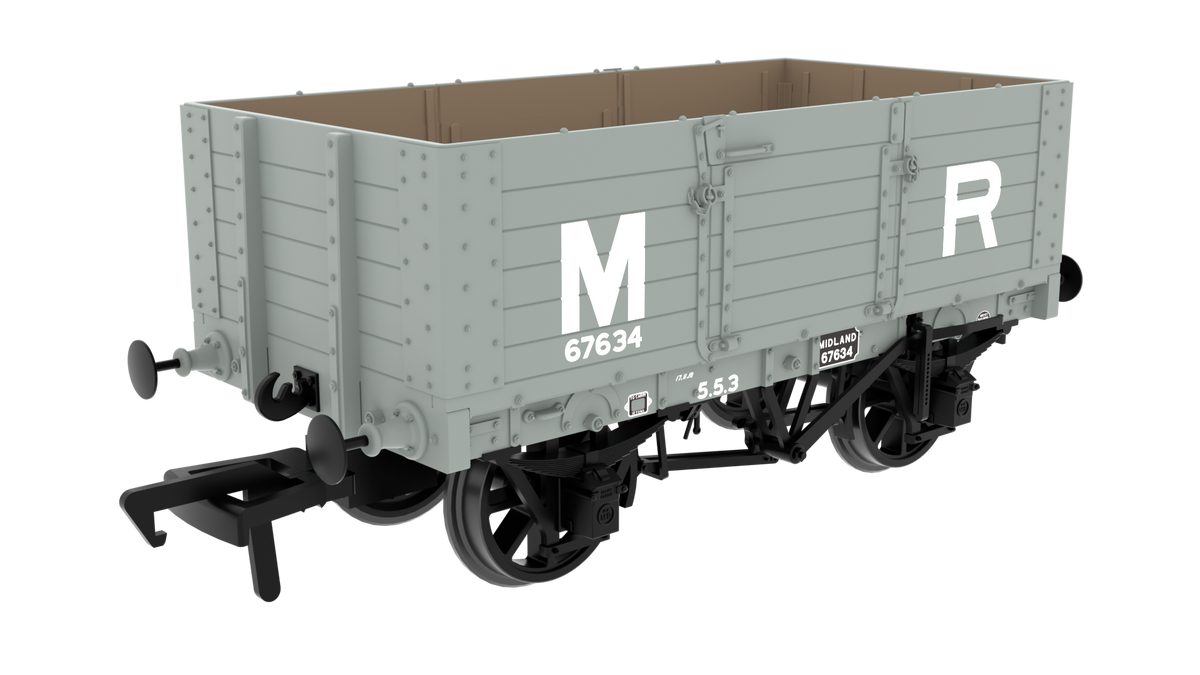
Product Details
| SKU | RAP-845203 |
|---|---|
| Vendor | Rapido Trains UK |
| Categories | Best selling products HO-OO New products OO Gauge Rolling Stock OO Gauge scale OO Gauge Wagons & Freight Pre-Orders Rapido Trains UK Rapido Trains UK Midland Railway D301 6-Plank Open Rolling Stock Wagons & Freight |
| Scale | OO Gauge |
| Share | |
| Features |
Product Description
- Short handbrake lever
- 10A axleboxes
- Tiedown bobbins
- Bottom doors
- Split-spoke wheels running in metal bearings
- High level of detail above and below the floor line
- High quality livery application
- NEM coupler pockets
- 1:76 scale, (OO gauge)
- UK designed
As the last century began, the need to transport higher quantities of minerals arose. The Midland appointed a new General Manager in 1901, and he wanted higher-capacity, longer 10-ton wagons that would give a better payload-to-tare weight ratio. A small experimental batch was produced to these requirements.
It was quickly determined that this was an impractical solution for the company. There were already enough cut and dried planks to keep the wagon builders busy for the following 3 years, but these were cut to fit the 8-ton design; It would take much longer for timbers to be cut and dried to fit the new design.
They compromised and elected to go up, rather than out. A 6-plank version of the previous 5-plank open was conceived. This new type of open wagon would also feature a hinged lifting section on the wagon doors' 6th plank. One thousand vehicles were built to this design by the Midland Railway and were constructed between 1901 and 1902. They were assigned as Diagram 301 (D301) when the wagon diagrams were introduced by the Midland Railway in 1907.
A further 80 were then made for the Somerset and Dorset Joint Railway, which the Midland shared responsibility and ownership of with the London & South Western Railway.
No further 10-ton wagons were built to this design, as the Midland opted for a different design when more were required.
Examples of D301 6-Plank open wagons survived into the grouping, and both the London Midland and Scottish Railway and Southern Railway acquired them. Sadly, there is no evidence of them making it into nationalisation or into preservation.