
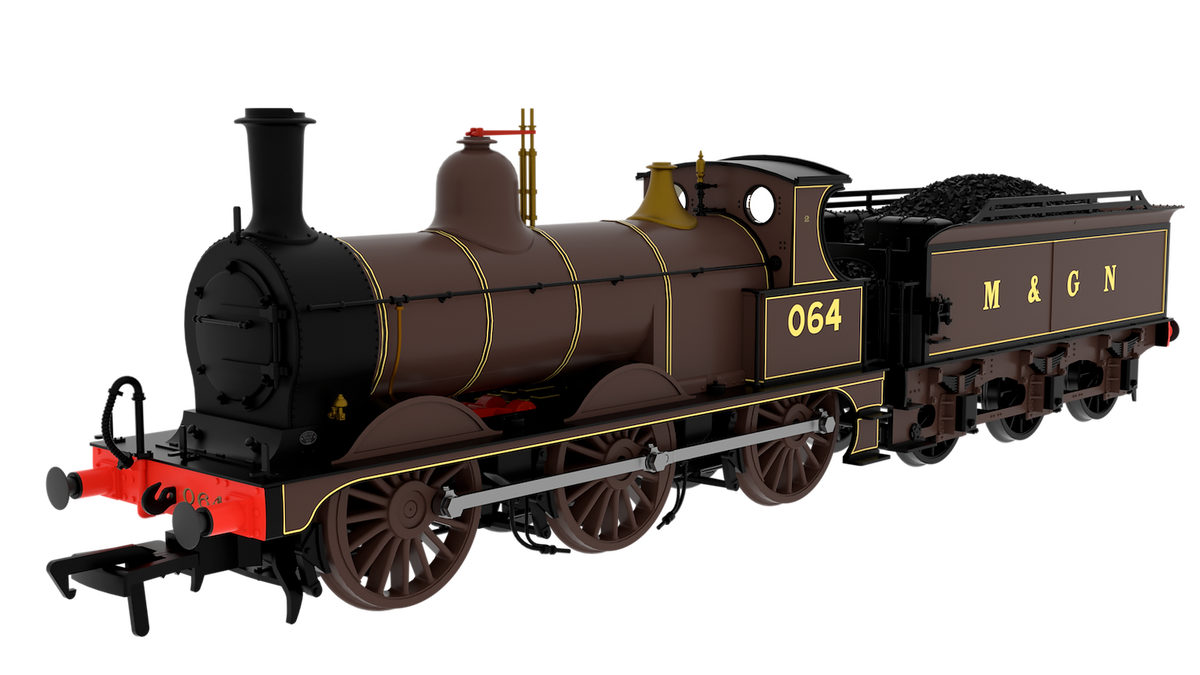
Rapido Trains UK 837015 MR Class M 0-6-0 - No.064 M&GN Dark Brown w/ LNER Number Steam Locomotive

- Pre-Order
Product Details
| SKU | RAP-837015 |
|---|---|
| Vendor | Rapido Trains UK |
| Categories | Best selling products Free Postage HO-OO Locomotives New products OO Gauge Locomotives OO Gauge scale OO Gauge Steam Locomotives Pre-Orders Rapido Trains UK Rapido Trains UK Midland Railway Class M 0-6-0 Steam Locomotives |
| Scale | OO Gauge |
| Share | |
| Features |
|
Product Description
MR Class M 0-6-0 - No.064 M&GN Dark Brown w/ LNER Number Steam Locomotive
Suitable for operation on 2nd radius curves (438mm or greater)
- Dome-riveted smokebox
- Deeley smokebox door
- 3-part boiler handrail
- Smokebox lubricator pots
- Melton Constable chimney with capuchon
- Tablet catcher on tender
- 21-pin DCC decoder socket
- Twin speakers in tender
- Museum quality paint finish
- MoPower stay-alive
- Diecast metal and plastic construction
- Smooth & powerful mechanism
- Highly detailed
- NEM 362 coupler pockets front and rear
- 1:76 scale, (OO gauge)
Throughout the 1890s, after the depression of the late 1880s, the Midland Railway had a dramatic increase in freight and mineral traffic. This required increasing its fleet of freight locos with more powerful examples to compensate for the increased loads.
The Midland Railway's Locomotive Superintendent, Samuel Waite Johnson, had a history of designing efficient freight locos. He designed a new single-framed 0-6-0 tender locomotive, a culmination of previous developments of this type of loco. The new class proved its worth and became the railway's premier freight locomotive at the turn of the last century. The new class was designated as the Class M.
Though the Class M was designed and primarily used as a freight locomotive, they were equipped to work vacuum-braked trains, so it was not uncommon for them to haul passenger services.
All but 10 of the Class M were built by outside contractors between 1892 and 1903.
A whopping 345 examples were built for the Midland Railway by Sharp, Stewart & Co. (85), Neilson & Co. (75), Kitson & Co. (50), Neilson, Reid & Co. (85), Dübs & Co. (20), Vulcan Foundry (20), and, of course, their own Derby Works (10).
With the Midland Railway joining forces with a variety of other railway companies in joint ventures and agreements, it's hardly a surprise that these plentiful locos found their way into these other companies' fleets.
The final batch built by Neilson, Reid & Co. between 1901 and 1902 was intended solely for Midland use; however, a decision was made to divert five to the Somerset and Dorset Joint Railway.
Johnson was also Locomotive Superintendent to the Midland and Great Northern Joint Railway Committee. In order that the M&GNR had freight locos that were also rated for passenger haulage, several locos were also ordered on behalf of the M&GN.
Sixteen were built by Neilson, Reid & Co. (8) and Kitson & Co. (8); the M&GNJR designated them as the Class D. This brought the total locos built to the Class M drawings to 366 across the three railway companies.
With the desire to further improve performance and power, much of the Class M fleet was upgraded with the new ‘H’ boilers. In the 1920s, these locos were refitted once more and received even larger Belpaire boilers, becoming the familiar Class 3F. Others received smaller Belpaire boilers, remaining Class 2F. Some of the S&DJR and M&GNJR locomotives also went through the same refits. Despite these refits, examples fitted with the original ‘B’ boiler soldiered on.
In 1923, the LMS inherited all of the surviving Midland locos in this condition, with the LNER taking charge of the remaining locos from the M&GNJR in 1936. The S&DJR engines had all been rebuilt as Class 3F by the time they became LMS stock in 1930.
None of the locos fitted with ‘B’ boilers made it into nationalisation. However, the class's legacy didn’t come to an end during the grouping era. Many of the surviving Class M locomotives that featured Belpaire boilers and were classified as 2F and 3F were used by British Railways. Sadly, there are no surviving examples in preservation.
