
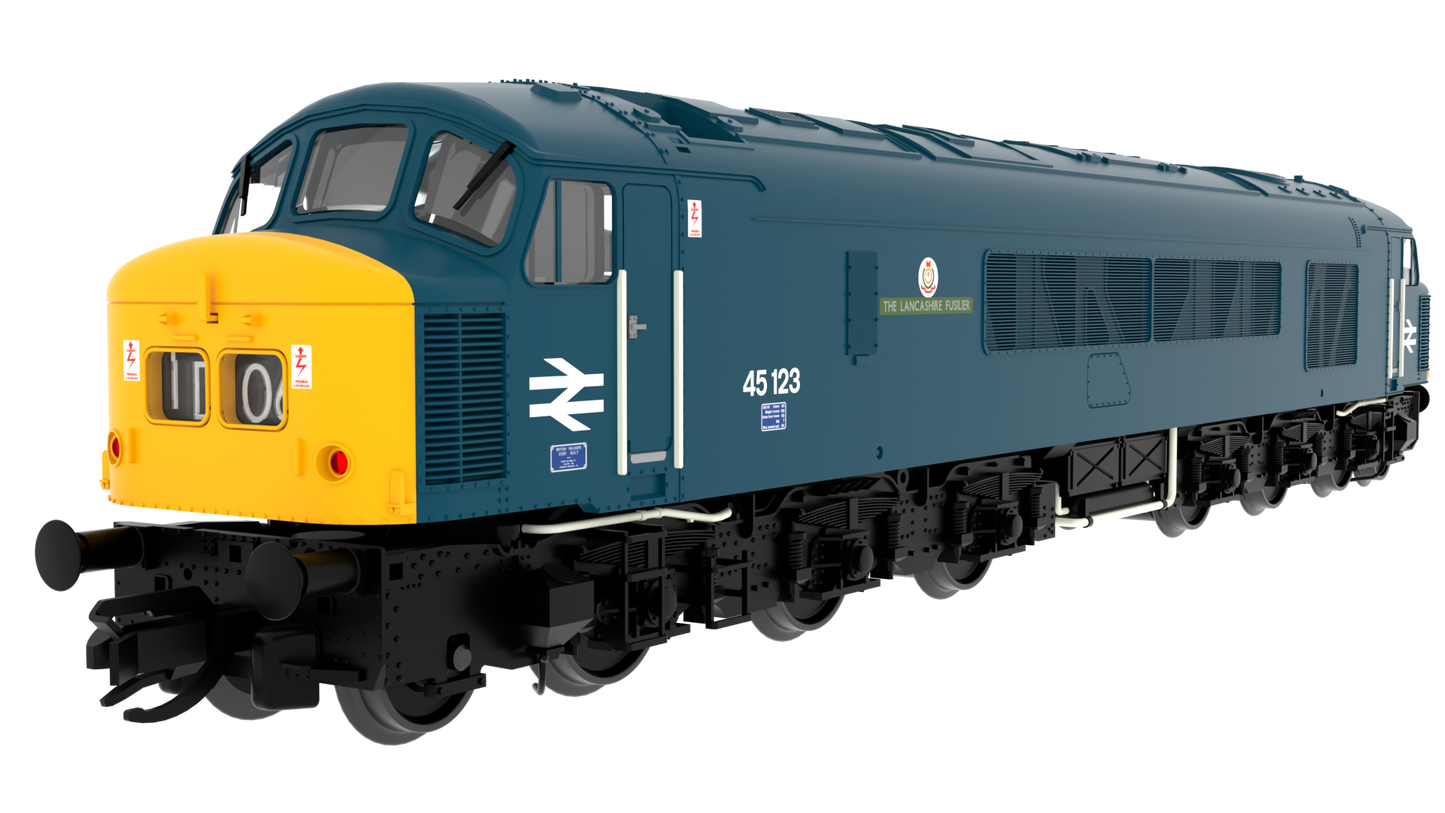
Rapido Trains UK 823104 Class 45 'Peak' 45123 "The Lancashire Fusilier" BR Blue With Headcode Blinds Diesel Locomotive

- Pre-Order
Product Details
| SKU | RAP-823104 |
|---|---|
| Vendor | Rapido Trains UK |
| Categories | Best selling products Diesel Locomotives Era 5 Free Postage Locomotives New products Pre-Orders Rapido Trains UK Rapido TT:120 BR Class 45/46 'Peak' TT:120 Scale |
| Share | |
| Features |
|
Product Description
Class 45 1Co-Co1 45123 "The Lancashire Fusilier" BR Blue With Headcode Blinds
- Split headcode panel
- Bodyside steps removed
- Bodyside lower panel
- Outer bogie sandboxes only
- Directional lighting
- HM7000 compatible
- Next18 decoder socket
- High quality motor and drive mechanism for smooth running
- Factory-fitted speaker in all models
- DCC sound option (with ESU LokSound 5 decoder)
- Bogie mounted NEM coupler pockets
- Separately fitted wipers
- Separately fitted radiator fan grill
- Optional buffer beam hoses to fit as required
With the success of the first Type 4 diesels, Derby Works began the development of the next generation of even more powerful locomotives, the Class 45 and Class 46. These would go on to form the bulk of the Midland mainline fleet for many years.
Despite the 45s and 46s not being named after mountains as their Class 44 counterparts had been, many were honoured with the names of famed British Army Regiments; however, they still retained the nickname ‘Peaks’.
The Class 45 and 46s were pretty much identical to the 44s, also weighing in at around 135 tonnes and powered by a diesel power unit produced by Swiss engineering company, Sulzer. However, the newer power units produced 2500 horsepower, 200 more than their predecessor.
This led to BR placing a more substantial order of 127 locos for Class 45s; this was so many in fact, that Crewe Works were also drafted in to assist Derby with their construction.
The first BR Class 45 entered service in late 1960, with the class soon becoming the main loco to work out of St Pancras on the Midland Line services, demoting the dwindling number of steam locos to cover local services or freight.
The final variant of the ‘Peak’ began production in 1961, now with Brush Electrical Equipment fitted after re-tendering for the next batch of locomotives. This tweaked peak would be known as the BR Class 46.
Externally, it looked almost identical, as it had the same engine and body; however, its electrical equipment had received an upgraded generator and different traction motors. Developed by the Brush Company of Loughborough, these upgrades replaced the previously used Crompton-Parkinson electrical equipment of the Class 44 and 45.
In total, 56 Class 46 locomotives were produced, with the last being built in 1963.
The 45s were intended to be allocated to multiple regions during their construction, and this was initially the case with locomotives allocated to London Midland and Western Region sheds as well as other regions for short stints of training. They soon settle down to more regular work on Midland Mainline and Western Region services. The 46s were used for more varied work, being seen on NE-SW cross-country services, long-distance freights from the West Country and some Trans-Pennine services.
With Class 45s and 46s often being seen working trains to destinations across the Southwest and alongside the iconic trainspotting location of Dawlish, it's no wonder the loco has a soft spot in many diesel enthusiasts' hearts.
With the introduction of the HSTs on the Midland Mainline and Cross Country routes, as well as the introduction of Class 56s to Coal traffic, the 45s were moved to the Trans-Pennine route to work passenger services across the north of the country.
The ageing fleet of well-travelled ‘Peaks’ started to be withdrawn throughout the 1980s. The last of the 44s were withdrawn in 1980, the 46s in 1984, and the final 2 Class 45s soldiered on until 1989. The last ‘Peak’, No.45106, was painted into an approximation of the original BR Green livery and regularly worked the 17:50 St Pancras – Derby service as well as a number of railtours. It sealed the fate of the class with an onboard fire after it failed at Wellingborough with a fuel leak, the ignition presumed to be from brake sparks while being towed dead, which sadly resulted in its inevitable retirement.
Prior to retirement, the class did have one final claim to fame. Class 46 No.46009 was acquired by the BR Research department to be used in an upcoming crash test. This famous and very public experiment would see BR test, under crash conditions, the integrity of its supposedly impenetrable Nuclear Flasks.
On July the 17th 1984, the loco and its train were allowed to run out of control along the old Dalby Test Track. With the train approaching its top speed, it crashed into a waiting nuclear flask wagon that had been positioned across the track. Unsurprisingly, the loco swiftly expired in the name of science, exploding in an impressive ball of flames and debris. The infamous footage taken on that day would be lapped up by railway enthusiasts across the world for many years to come.
Not all of the remaining ‘Peaks’ were used as test subjects, and we can be thankful that a number of these locos would sit waiting to be scrapped until 1994, giving budding enthusiasts the perfect opportunity to preserve them. Incredibly, 12 Class 45s and 3 Class 46s were saved for preservation.