
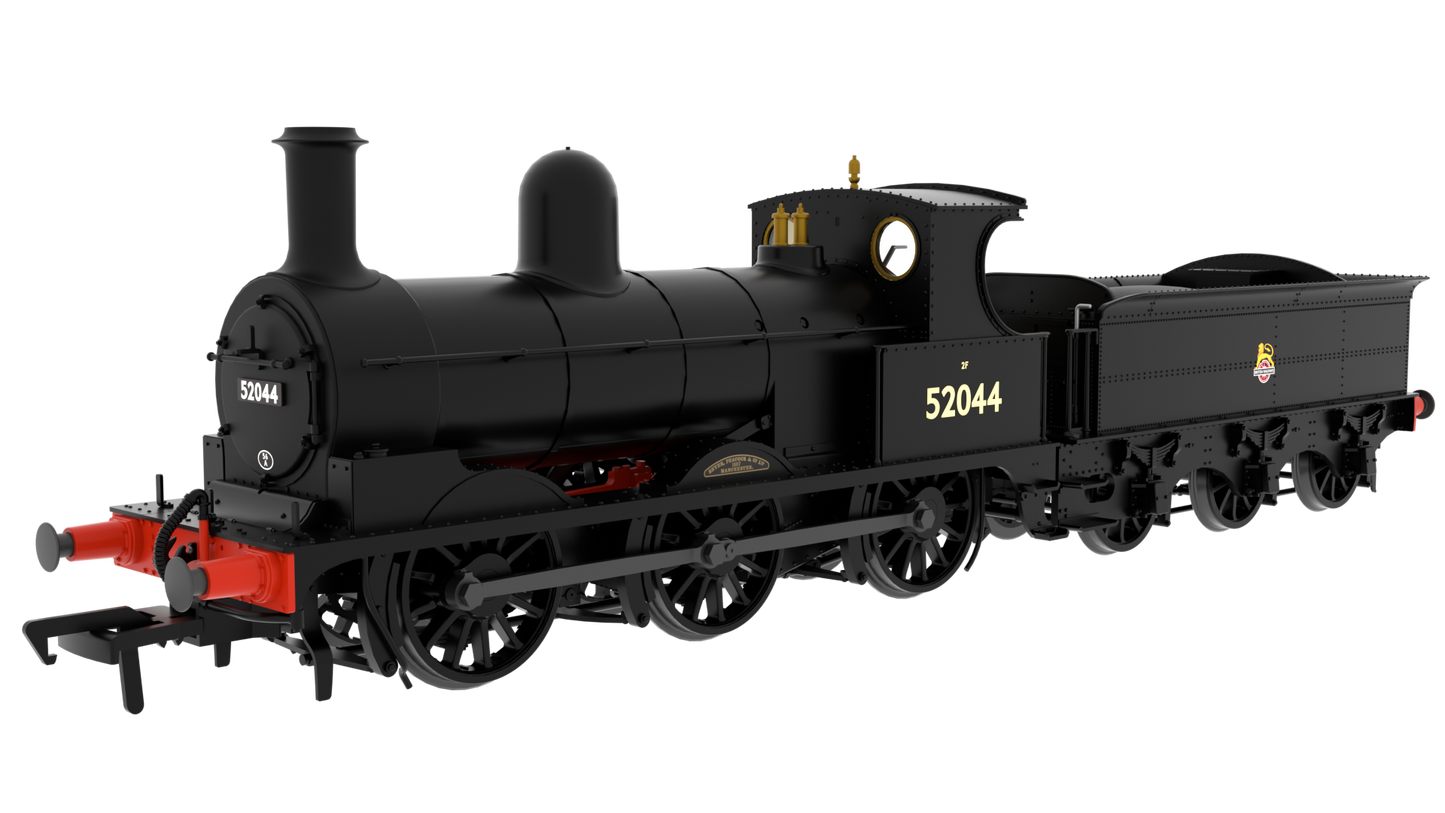
Rapido Trains UK 817512 Class 25 'Ironclad' 0-6-0 No.52044 Lancashire & Yorkshire BR Early Crest (As Preserved) Steam Locomotive - DCC Sound


- Pre-Order


Product Details
| SKU | RAP-817512 |
|---|---|
| Vendor | Rapido Trains UK |
| Categories | Best selling products DCC Sound Fitted Era 4 Free Postage HO-OO Locomotives New products OO Gauge Locomotives OO Gauge scale OO Gauge Steam Locomotives Pre-Orders Rapido OO Gauge L&Y Class 25 ‘Ironclad’ 0-6-0 Rapido Trains UK Steam Locomotives |
| Scale | OO Gauge |
| Share | |
| Features |
|
Product Description
Class 25 'Ironclad' 0-6-0 No.52044 Lancashire & Yorkshire BR Early Crest (As Preserved) Steam Locomotive - DCC Sound
Suitable for operation on 2nd radius curves (438mm or greater)
- LMS Style Smokebox Door
- 3 Piece Boiler Handrail
- Ross Pop Safety Valves
- Coreless motor with flywheel
- 21 pin decoder socket in tender
- Large tender mounted speaker
- MoPower stay-alive fitted.
- Plunger loco pickups
- Tender wheel bearing pickups
- Dynamic firebox flicker
- NEM pockets front and rear
When William Barton Wright took the position of Locomotive Superintendent of the Lancashire and Yorkshire Railway in 1875, he began replacing the ageing L&Y’s loco fleet immediately.
An order was placed with Kitson & Co. for the first batch of 0-6-0 tender locos. These new engines were based on a small batch of
locomotives that Kitson’s had recently completed for the Taff Vale Railway.
Kitsons delivered 22 examples between the summer of 1876 and early 1878; the new locos would be designated as the Class 25.
The Class 25s had clearly met Barton Wright’s expectations, as 18 more were ordered from Sharp, Stewart & Co. in 1877. This was before all the Kitson examples had been delivered. The following year, the L&Y then began building Class 25s at their own works at Miles Platting in Manchester.
Further batches would later be outsourced to other private manufacturers, with orders continuing through to 1885. These include Vulcan and Beyer Peacock in addition to further examples from Kitson’s. The last of the class was delivered in 1887.
Between the 5 builders of the Class 25, a total of 280 locos were completed. Though there were subtle differences from batch to batch, much of the design remained the same.
Although designed as a freight loco, they proved themselves effective at mixed traffic duties and soon earned the nickname ‘Ironclad’. This was inspired by the battleships that were built around the same time. As they were efficient and quite numerous, Class 25s were assigned to most sheds throughout the L&Y.
Barton Wright’s successor, John Aspinall, took over in 1886. His new designs of larger freight locos quickly outclassed the Class 25. So Aspinall promptly set about repurposing the older Class 25 examples for local goods and shunting duties. This was done by converting them to saddle tanks. By the time the conversions had been completed, only 50 ‘original’ Class 25 locos remained in service.
The remaining locos would be inherited by the LMS, which gave them the power classification 2F. Withdrawals began in 1930. By the time British Railways took ownership of the Class 25s, just under half remained.
After an impressive 72 years of service, the last surviving member of the class was withdrawn in 1959. This was loco No.52044 (L&Y No.957).
It would have been the final curtain for this long-lived class had it not been for the fortuitous intervention of Tony Cox. Mr. Cox was keen to save an L&Y loco and purchased No.957 from British Railways in 1960. This made it the second mainline British Railways loco to avoid the scrapheap and move to private ownership. No. 957 would be moved to the Keighley & Worth Valley Railway in 1965, where it remains to this day.
To many people, No. 957 is better known as the ‘Green Dragon’. Repainted into the striking green livery of the fictitious Great Northern and Southern Railway, it took a starring role in the 1970 feature film ‘The Railway Children’. Earning itself worldwide fame. It also featured in several other BBC motion pictures, such as ‘Born and Bred’ and the remake of ‘The Hound of the Baskervilles’.
The Rapido Trains UK OO Gauge rendition of the L&Y Class 25 ‘Ironclad’ 0-6-0 will be available in a variety of liveries, including two that represent it during different periods of its preservation history