
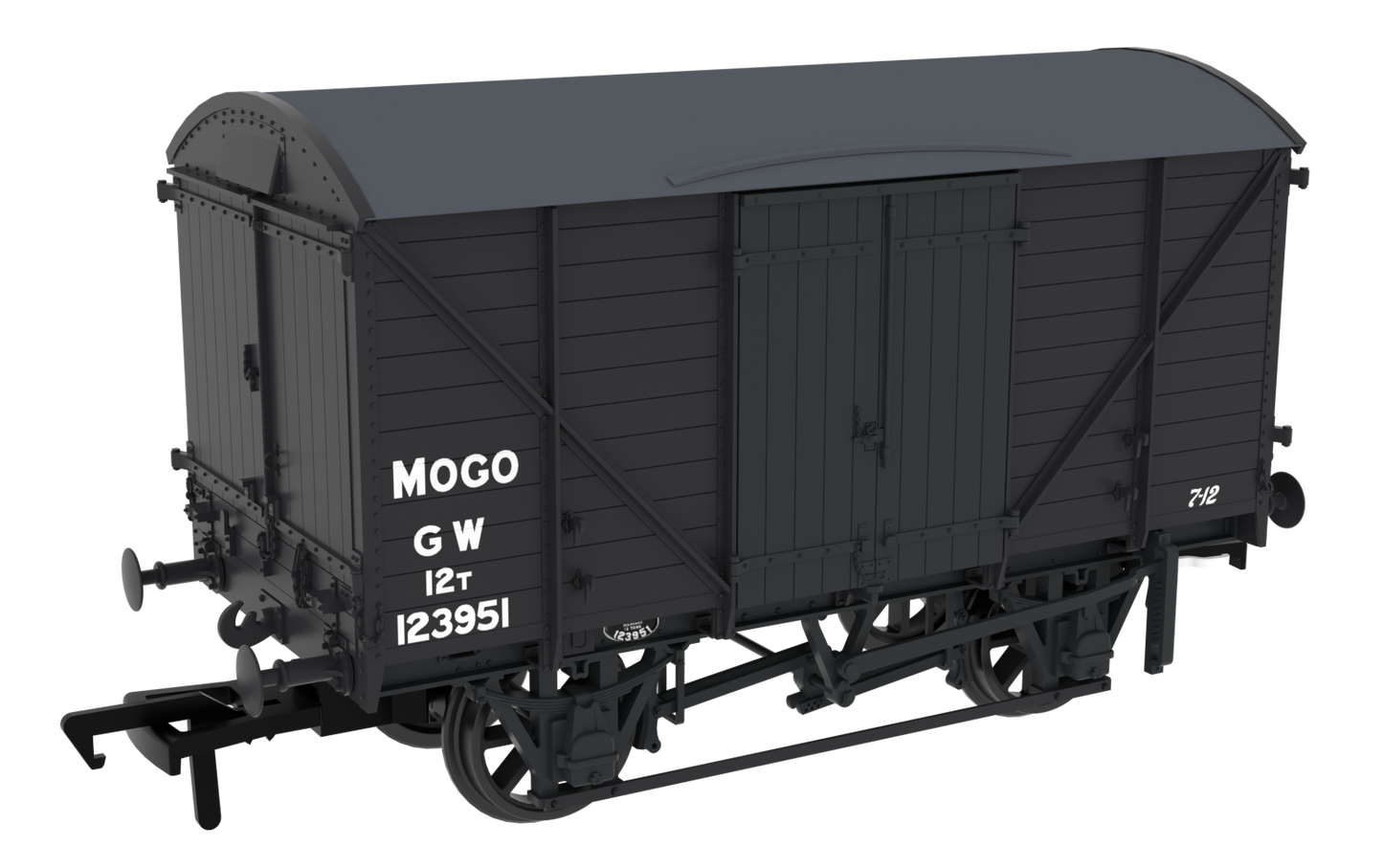
Rapido Trains UK 813304 Diagram G31 MOGO Van - No.123951 GWR Post-36 Grey

- Pre-Order
Product Details
| SKU | RAP-813304 |
|---|---|
| Vendor | Rapido Trains UK |
| Categories | Best selling products Era 3 HO-OO New products OO Gauge Rolling Stock OO Gauge scale OO Gauge Wagons & Freight Pre-Orders Rapido Trains UK Rapido Trains UK GWR RCH OO Gauge Wagons Rolling Stock Wagons & Freight |
| Scale | OO Gauge |
| Share | |
| Features |
|
Product Description
Diagram G31 MOGO Van - No.123951 GWR Post-36 Grey
- Planked body
- Planked doors
- Spoked wheels running in metal bearings
- NEM 362 Coupler Pockets
- 1:76 scale, (OO gauge)
- UK-designed
By the 1930s, the popularity and accessibility of the motor vehicle had exploded in the UK. Many people had opted to drive for the first time; however, the conditions of Britain's roads and the reliability of vehicles of the day didn’t facilitate excessively long journeys.
Thankfully, the GWR were well equipped and experienced at transporting road vehicles, with examples of open and covered carriage trucks being used way back into the pre-grouping era. But this was mainly carts of differing shapes and sizes.
The new motor vehicle presented a new set of challenges, namely the sheer number that needed to be moved. But they were self-propelled, so loading could be done in a slightly different way.
The GWR introduced its first Motorcar Goods Wagon in 1905. This lengthy designation was shortened to MOGO by the GWR. The MOGO was the natural evolution of the traditional covered carriage truck.
By 1933, it was quite apparent that the popularity of the car was so much so that thousands were being built for export.
Several well-known car builders wanted to transfer their vehicles from the factory to the dock by rail. However, the GWR were reluctant to produce wagons that were exclusively designed for this purpose. Any new wagon design needed to be suitable for transporting vehicles and general purposes, in case the movement and export of cars ceased. An almost comical thought process by today's standard.
They settled on Diagram G31. These had the same RCH underframe design as the X9 MICA A, but had an entirely different body, vacuum brakes as standard, 3-hole steel disk wheels, and RCH axleboxes. The G31 MOGO were rated to carry 12 tons. They featured doors at both ends and a short flap with blocks that could hinge down to rest on the buffers. This allowed vehicles to drive through from wagon to wagon when they were being loaded.
Each wagon could carry one road vehicle, which was easily accessible as there was no internal framing, and could be secured using removable wheel beams and chains.
They also had side doors and vents on each end so they could be used for general merchandise purposes.
A total of 350 G31 MOGOs were built between 1933 and 1936.
GWR would revise this design in 1946. The new design was almost identical to the G31; however, where the G31 used vertical wooden planks on its side panels and doors, the new design used plywood sheets. This new design was given the diagram G43, and 100 vehicles of this prototype were built between 1946 and 1947.
The G31 and G43 MOGOs were used by the GWR throughout their life for both of their intended purposes. Once inherited by British Railways, both prototypes continued to be used for motor vehicles and general goods.
They worked in revenue stock until the 1960s, when they were sadly withdrawn along with a plethora of similar wagons. This was following several derailments of short wheel-based wagons.
Thankfully, numerous examples survived through to the 1970s in departmental use. This was probably due to how useful a covered wagon with doors on both its ends and sides can be.
Quite a few examples of the G31 and G43 MOGO survived into preservation. Restored examples can be found at lots of preserved railways, including the Seven Valley Railway, Bristol Harbour Railway, and Didcot Railway Centre.