
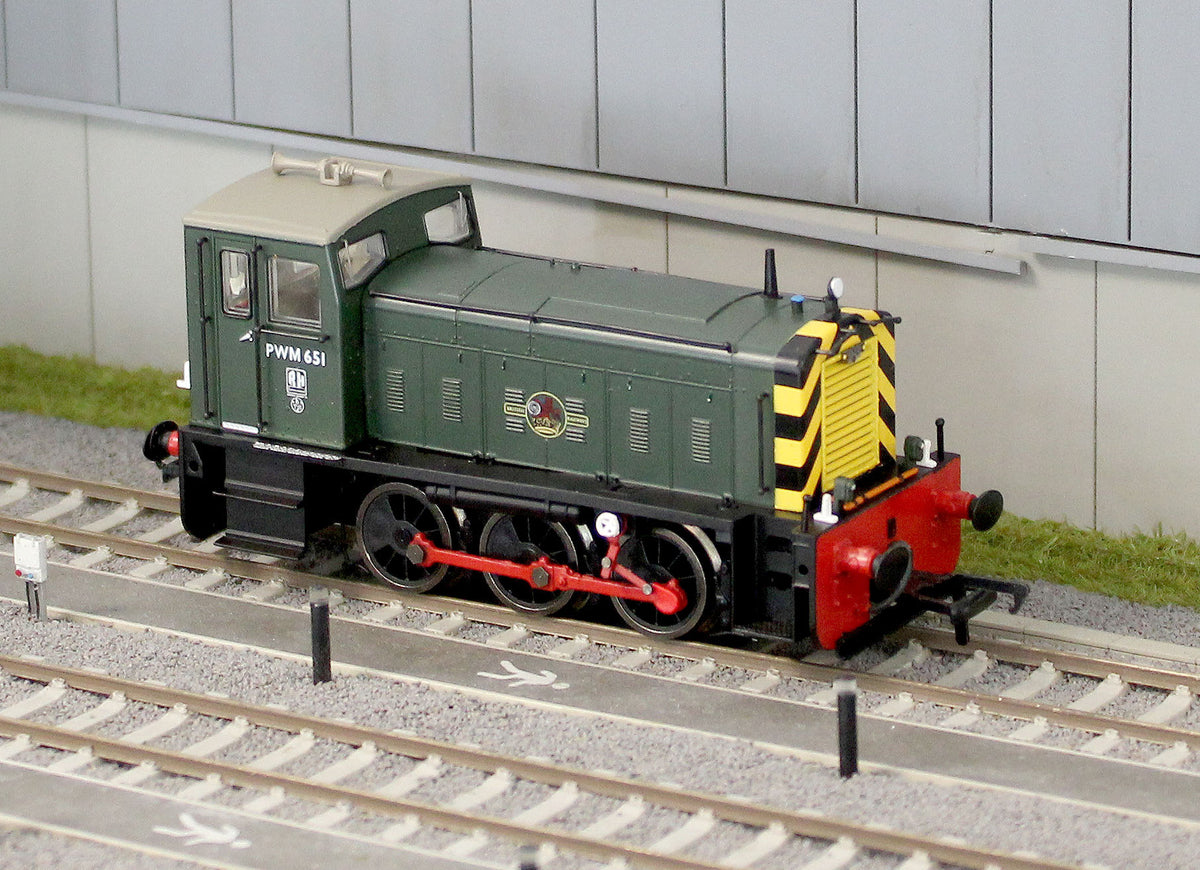
Heljan MR-402 Ruston PWM 165DE Shunter BR Green PWM651 Diesel Locomotive


Product Details
| SKU | HEL-MR-402 |
|---|---|
| Vendor | Heljan |
| Categories | Bargains Best selling products Diesel Locomotives Era 5 Heljan Heljan Ruston PWM 165DE Shunter In stock Items Latest Releases Locomotives New products |
| Share | |
| Features |
|
Product Description
- Highly detailed model with separately fitted parts including handrails, headlamp, grab irons, air tanks, horns and more
- Fitted with a powerful coreless motor and flywheel driving the central axle with all-wheel pickups
- Digital & Sound capability - NEXT-18 decoder socket with space for a 15mm x 8mm x 4.5mm speaker
- Switchable cab lights using magnetic wand device
- Moving lubricator arm
- NEM tension lock couplings
- Accessory pack including coupler blanking plates, lamp irons, pipes and cosmetic couplings
History
The origins of these machines can be traced back to July 1950 when Lincoln-based industrial locomotive builder Ruston & Hornsby delivered the first of its new ‘165DE’ type. This 150hp diesel-electric design replaced the older ‘165DS’ diesel-mechanical, 124 of which were built to six different gauges.
The following year, BR Western Region identified the modern ‘165DE’ as an ideal locomotive for handling track laying equipment trains during engineering possessions. The first machine, PWM650, was ordered in November 1951 and delivered to the WR at Swindon Works on January 5th, 1953. It was basically a standard industrial ‘165DE’ but with modifications to meet BR requirements, including a ‘deadman’s brake pedal’, radiator shutters, lamp brackets, cab heater and the ability to disconnect its traction motor when it was being towed between depots and work sites.
In the late-1950s, BR began to replace traditional 60ft lengths of rail with continuous welded rail and several new pre-assembly depots (PADs) were established around the Western Region. The success of PWM650 led the WR to order four additional ‘165DEs’ from Ruston & Hornsby in July 1958, with one to be allocated to each PAD at Newland, near Malvern, Theale in Berkshire, Radyr in Cardiff and Taunton Fairwater, plus the Hookagate welded rail depot in Shrewsbury.
PWM651-654 were delivered between May and October 1959 and featured a number of modifications over their predecessor. Larger diameter (3ft 4in) wheels were fitted, along with train vacuum brakes, improved coupling rods, a mechanical lubricator, two-tone hooter and a modified cab with larger windows and louvred window spinners.Over the next 30 years, the ‘PWMs’ led a low-profile existence, carrying out their essential engineering duties largely out of the public eye. As well as their allocated bases, the locomotives were also seen at Swindon, Worcester, Cardiff Canton depot, Gloucester and Reading, providing a rare ‘cop’ for eagle-eyed trainspotters.
All were initially painted BR dark green, but by the early-1970s PWM651/653 carried a lighter drab olive green with a white cab roof. By the late-1970s all were in BR blue, but was replaced from 1981 by all-over yellow. Under the TOPS computer system, PWM650-654 became Class 97/6 and were renumbered 97650-654 in the late-1970s.
By the early-1990s, only 97651/654 were still in regular use with 97653 being retained as spares donor (scrapped in 2011), 97652 being scrapped in October 1990 and 97650 stored in 1987 and later acquired by Lincoln City Council.
Remarkably, 97654 was sold in 1996 and moved to Slateford Yard in Edinburgh with a view to use on Forth Bridge engineering trains. However, this never took place and the locomotive later joined 97650 and 97651 in preservation. Today, 97650/654 are cared for by the Heritage Shunters Trust at Rowsley in Derbyshire and 97651 is operational at the Swindon & Cricklade Railway.
In total, Ruston & Hornsby built more than 150 ‘165DEs’ to industrial users in the UK and overseas, in both 0-4-0DE and 0-6-0DE variants.