
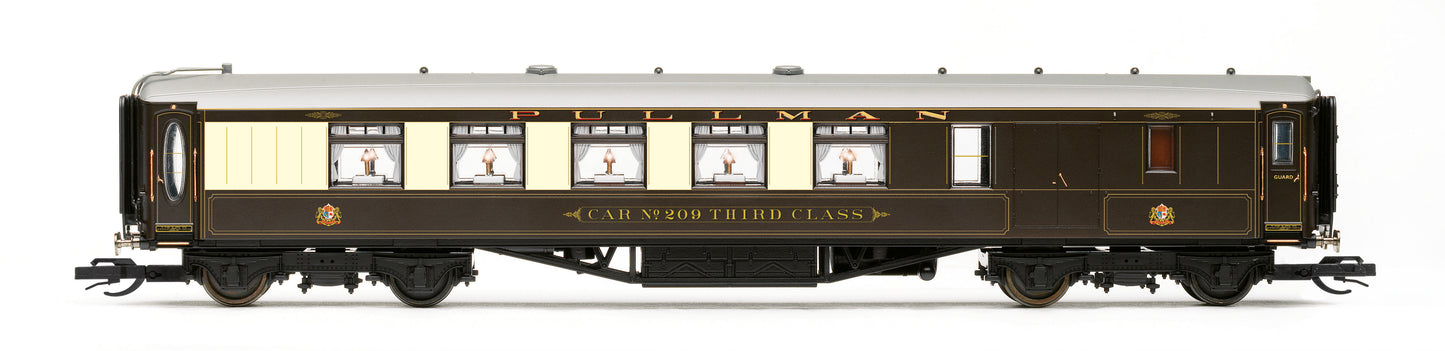
Hornby TT4004C Pullman Third Class Brake Car 'Car 209'

- Pre-Order
Product Details
| SKU | HOR-TT4004C |
|---|---|
| Vendor | Hornby |
| Categories | Best selling products Carriages & Coaches Era 3 Era 4 Era 5 Hornby Hornby Due Soon Hornby TT:120 Q2 2026 Announcements Locomotives New products Pre-Orders Rolling Stock TT:120 Scale |
| Scale | TT:120 Gauge |
| Share | |
| Features |
|
Product Description
Capture the elegance of luxury train travel with the K-Type Pullman Cars in TT:120, with crisp moulded bodyshells, detailed interiors and working table lamps.
This new offering of 3rd Class Brake numbered 209 is perfect for pairing with previous runs of Pullman coaches, and could easily run behind a 1940s steam locomotive, or a modern Class 50 or 66 on a charter train!
Model Specification:
- Highly detailed model of 3rd Class Brake
- Defined bogie mouldings with rivet detailing
- Detailed underframe
- Moulded interior
- Kinematic NEM coupling mechanism
- Accessory Pack
Electronics:
- Working table lamps on analogue or DCC.
Livery:
- Lined Pullman cream and brown
- Grey roof
- Printed ‘Car No.209 Third Class’ running number
- Semi-gloss finish
- Era 3, 4 and 5
History:
Pullman carriages were first seen on Britain’s railways in 1874, operated by the Midland Railway between Bradford Forster Square and London St Pancras. Initially, the coaching stock was imported from America, but the British ‘Pullman Car Company’ was formed in 1882, named after American pioneer, George Pullman. The company entered into contracts with the various railway companies of the day, to offer opulent first class seating complete with at-table steward service.
The Pullman Car Company had its own workshops at Brighton and manufacture of Pullman Cars was also carried out by the Birmingham Railway Carriage & Wagon Company and the Metropolitan Cammell Carriage & Wagon Company.
Pullman cars provided a superior standard of First Class travel, with Kitchen Cars introduced that could serve cooked meals, served at the passenger’s table, which would be dressed with clean white linen and the finest crockery and tableware. Before long, Pullman trains were operating on all of the principal long-distance routes in Britain.
Pullman services were operated by all of the ‘Big Four’ companies, even the Great Western which was initially reluctant to have them as it believed its own coaches were luxurious enough. All First Class Cars had names, in a Greek naming convention, though when Third Class vehicles were included in trains, these instead had the car number emblazoned on each side. All vehicles had a distinctive umber and cream livery, with the Pullman coat of arms proudly displayed.
After Nationalisation, the Pullman Car Company was bought by the British Transport Commission in 1954, by which point, apart from ten recently built cars, the fleet had become somewhat elderly. It was decided to modernise Pullman services as part of the British Railways 1955 Modernisation Plan, with new coaching stock and diesel or electric haulage. Although moderately successful, services declined, and the last Pullman trains operated under BR in 1972