
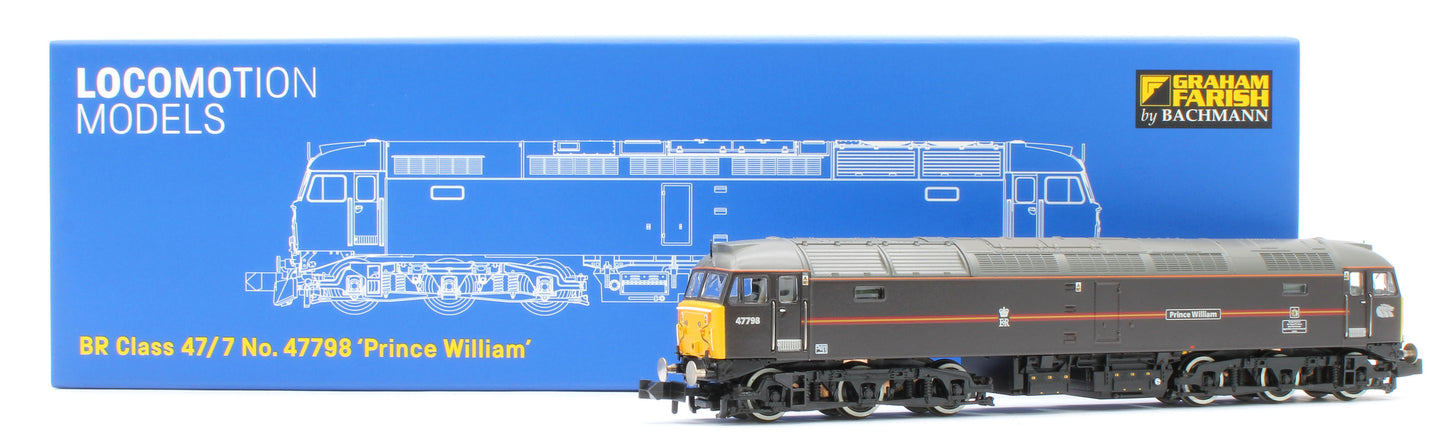
Graham Farish 372-262NRMSF Class 47/7 47798 'Prince William' EWS Royal Claret (Locomotion Models Exclusive) Diesel Locomotive - DCC Sound


Product Details
| SKU | GF-372-262NRMSF |
|---|---|
| Vendor | Graham Farish |
| Categories | Best selling products Class 47 Locomotives DCC Sound Fitted Diesel Locomotives Era 9 Graham Farish In stock Items Latest Releases Locomotion Models / Railway Museum Limited Editions Locomotives N Gauge Diesel Locomotives N Gauge Latest Releases N Gauge Locomotives N Gauge scale New products |
| Scale | N Gauge |
| Share | |
| Features |
|
Product Description
Model Features:
- Die-cast chassis with all wheel drive.
- NEM coupling pockets.
- Directional lighting
- Comes with accessory pack including cosmetic couplings and buffer beam pipework.
The British Rail Class 47, also known as Brush Type 4 locomotives, stands as a testament to the ingenuity of railway engineering. Developed by Brush Traction in the 1960s, but tracing their origin back to the 'Modernisation Plan of 1954', these diesel-electric engines have not only shaped the landscape of British rail transport but have also left an indelible mark on the history of locomotive manufacturing. Between 1962 and 1968, a remarkable 512 Class 47 locomotives rolled off the production lines at Brush’s Falcon Works in Loughborough and British Railways Crewe Works. This impressive quantity awards these locomotives their status as the most numerous class of British mainline diesel locomotive ever produced.
The versatility of the Class 47s is reflected in their over 55 years of service, operating both freight and passenger duties on British rails. Even today, a significant number of these locomotives continue to operate on both mainline and heritage railways, showcasing their enduring reliability and adaptability.
In the early 1970s, the Class 47 fleet underwent a renumbering process into the 47xxx series, with sub-classes created based on the specific electrical equipment fitted to each locomotive. Notably, two locomotives from the Class 47/7 sub-class, namely No.47798 ‘Firefly’ and No.47799 ‘Windsor Castle, were dedicated for Royal Train service and later renamed 'Prince William’ and 'Prince Henry' respectively. Their distinguished service continued until 2004 when they were succeeded by Class 67 locomotives, prompting their withdrawal for preservation. ‘Prince William’ is now part of the National Collection and is currently housed at the National Railway Museum in York.