
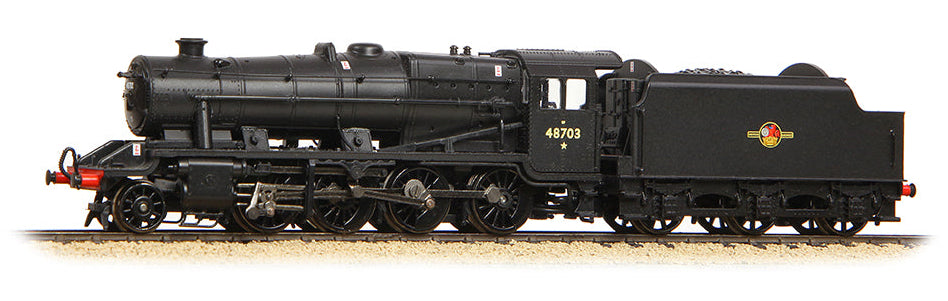
Graham Farish 372-163A LMS Stanier 8F 48703 BR Black (Late Crest) Steam Locomotive

- Pre-Order
Product Details
| SKU | GF-372-163A |
|---|---|
| Vendor | Graham Farish |
| Categories | Bachmann Winter 2026 Announcements Best selling products Era 5 Free Postage Graham Farish Locomotives N Gauge Latest Releases N Gauge Locomotives N Gauge scale N Gauge Steam Locomotives New products Pre-Orders Steam Locomotives |
| Scale | N Gauge |
| Share | |
| Features |
|
Product Description
We’re delighted to welcome the Stanier 8F back to the Graham Farish range and our award-winning model is a fitting replica of this all-time icon of British locomotive design. Few other classes were as numerous as the 8Fs which played a vital role in the allied victory during World War Two, before going on to serve British Railways until the very last day of steam.
Constructed around a diecast metal running plate and chassis, the Graham Farish 8F boasts a highly detail bodyshell, cab and tender along with many extra details that are added individually. With a powerful coreless motor providing drive through a diecast metal gearbox, our 8F is a strong and powerful performer capable of hauling long and heavy trains. A comprehensive tooling suite caters for the various detail differences seen across the 8F fleet allowing many of the 800+ locomotives to be accurately portrayed at any given time in their operation career.
-
Graham Farish N Scale
-
Era 5
-
Pristine BR Black (Late Crest) livery
-
Running No. 48703
-
Equipped with a Next18 DCC Decoder Socket – Recommend Decoder item No. 36-567A
-
Length 138mm (over couplings)
DETAIL VARIATIONS SPECIFIC TO THIS MODEL
-
Welded Stanier 4,000-gallon Tender
-
Smokebox Door with Large Numberplate
-
High Front Lamp Iron (Top)
-
Straight Reverser Rod
-
Steam Lance Valve Mounted Low on the Smokebox and with External Pipework
-
Countersunk Bufferbeam Rivets
-
Fabricated Wheel Balance Weights
GRAHAM FARISH STANIER 8F CLASS SPECIFICATION
MECHANISM:
-
Coreless motor
-
Electrical pickup from all driving and tender wheels
-
Separate metal bearings fitted to each driving wheel axle
-
Metal bearings fitted to each tender wheel axle
-
Diecast metal chassis block
-
Diecast metal gearbox, with gearing arranged for prototypical running speeds and haulage capabilities
-
9mm (N gauge) wheels to NEM310 standards with authentic profile and detailing
-
Traction tyres fitted to the rear driving wheels for assured haulage capabilities
-
Valve gear of metal construction
-
Discreet fixed locomotive to tender drawbar with integral electrical connections
-
Coupling pocket to NEM355 standards fitted to the front bogie
-
Removable coupling pocket to NEM355 standards fitted to the tender chassis
-
Designed to operate on curves of second radius (263.5mm) or greater
DETAILING:
-
Diecast metal running plate
-
High-precision, injection-moulded bodyshell, cab and tender with separately fitted detail parts including smokebox door, lower front lamp irons, steam pipes, whistle and reverser
-
Separately applied metal components including handrails, buffers, injector feedpipes and safety valves
-
Dome, filler cap, water scoop and vacuum pipe added to the tender as separate parts
-
Tender fitted with metal coal-effect load
-
Detailed cab interior including boiler backhead controls and gauges
-
Hinged and posable metal fall plate between the locomotive and tender
-
Each model supplied with a full set of accessory parts including cab doors, front steps and cylinder covers
DCC:
-
Next18 DCC decoder interface located in the tender
SOUND:
-
Speaker installed in the tender of all models for optimum sound reproduction
-
Zimo MS581N18 DCC Sound Decoder pre-installed in SOUND FITTED versions
-
Sound files produced specifically for the Graham Farish Stanier 8F Class using recordings from real locomotives
-
SOUND FITTED models operate on DCC and Analogue control as supplied
LIVERY APPLICATION:
-
Authentic liveries applied to all models
-
Multiple paint applications employed on each model using LMS and BR specification colours
-
Logos, numerals and text added as appropriate using multi-stage tampo printing process, employing authentic typefaces, logos and colours
LMS 8F HISTORY
The first of Stanier’s 2-8-0 8Fs emerged from Crewe Works in 1935, one of 331 locomotives ordered by the LMS, however by 1945 a total of 852 8Fs had been built. The extra 521 came about as a result of their engineer Robert Riddles being seconded to the Ministry of Supply during World War Two. Riddles halted an order for ROD 2-8-0s, the engines that had proved so important during the First World War, and instead chose the Stanier 8F as the War Department’s standard steam locomotive for the Second World War.
The ministry of supply ordered 208 for the War Department, meanwhile 245 were ordered for the LMS by the Railway Executive Committee who had taken control of the Big 4 during the conflict. These were built by the SR, GWR and LNER, the latter pair effectively keeping the locomotives that they constructed on loan until peacetime returned. Add to this 68 locomotives that the LNER decided to order for its own fleet, becoming the Class O6, of which 43 were built in-house at Doncaster and Darlington and 25 came from Brighton Works.
The War Department locomotives were shipped primarily overseas, serving with the Middle East Forces of the British Army. Many did not return, having been either lost in transit, lost in battle or sold to the state railways in the countries they had served in once their turn in action was over.
In 1948 British Railways inherited 624 8Fs upon Nationalisation, these being the majority of the LMS fleet give or take a few dozen that were requisitioned, and those operated by the GWR and LNER. Following repatriations and the return of surplus locomotives to BR from military use, the 8F fleet peaked at 666 engines between 1957 and 1960, when the first succumbed to withdrawal. With few exceptions they were allocated to the London Midland Region and found plentiful work hauling all manner of goods plus summer weekend workings and excursion traffic where they turned their hand to passenger haulage with ease.
It would be 1964 before withdrawals reached double figures and by the start of 1968, the final year of steam on British Rail, 150 8Fs were still in traffic, centred around the final bastion of steam in the North West of England. 8F No. 48518 would take responsibility for the final steam-hauled goods train on BR on 3rd August, followed on the 4th, the final day or ‘normal’ steam, by No. 48773 hauling a leg of the Locomotive Club of Great Britain’s ‘Farewell to Steam Railtour’.
Preservation dealt the 8F a meagre hand with just eight of the 852 locomotives built still extant in the UK today. A further six can be found abroad in Turkey, Israel and Iraq, bringing the total to 14 survivors.