
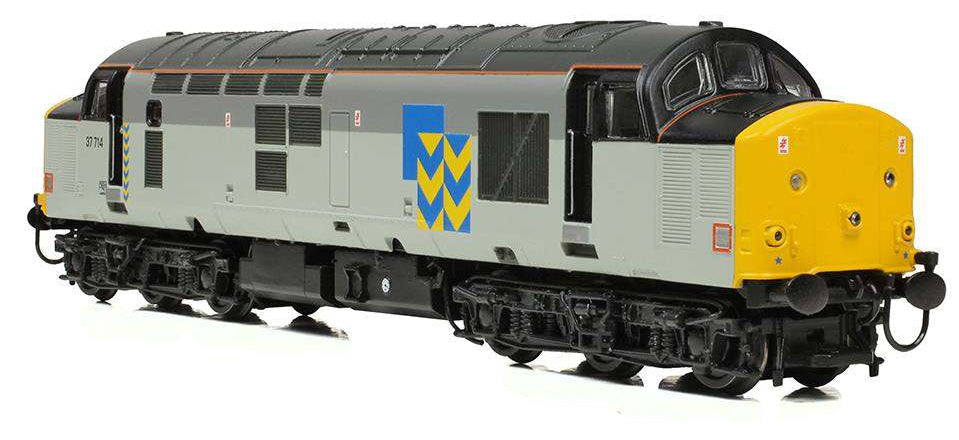
Graham Farish 372-111SF Class 37/7 37714 BR Railfreight Metals Sector Diesel Locomotive - DCC SOUND


- Pre-Order


Product Details
| SKU | GF-372-111SF |
|---|---|
| Vendor | Graham Farish |
| Categories | Bachmann Autumn 2026 Announcements Bachmann Due Soon Best selling products Class 37 Locomotives DCC Sound Fitted Diesel Locomotives Era 8 Free Postage Graham Farish Locomotives N Gauge Diesel Locomotives N Gauge Latest Releases N Gauge Locomotives N Gauge scale New products Pre-Orders |
| Scale | N Gauge |
| Share | |
| Features |
|
Product Description
The Class 37 is back in N Scale and better than ever thanks to this all-new model by Graham Farish. Depicting a sub-class never-before modelled in N, the Class 37/7, the new Graham Farish model has been designed from the rails up to create a masterpiece in miniature befitting one of Britain’s best loved diesel locomotives.
Combining a precision moulded bodyshell with a high performance chassis, the Graham Farish Class 37’s technical specification includes directional lights with independent control at either end and cab lights for DCC users. The smooth curves and crisp lines of the Class 37 are replicated in miniature with uncompromising quality, creating a model that is brought to life by the exquisite livery application which uses authentic colours, fonts and logos for an authentic finish. Coming complete with SOUND FITTED, you can take your operating experience to the next level and enjoy realistic sound effects thanks to the pre-installed Zimo MS581N18 DCC Sound Decoder which even includes an internal energy storage buffer to provide a small backup in the event of brief power interruptions at low speeds.
- Graham Farish N Scale
- Era 8
- Pristine BR Railfreight Metals Sector livery
- Running No. 37714
- SOUND FITTED – Fitted with a Zimo MS581N18 DCC Sound Decoder
- Length 140mm (over couplings)
DETAIL VARIATIONS SPECIFIC TO THIS MODEL:
- Originally built as a Series One Locomotive
- Headcode Boxes Removed and End Doors Plated Flush
- High Intensity Headlight
- Bufferbeam Valance Removed
- Oval Buffers
- English Electric Cantrail Grilles
- One-part Nose Grilles
- Rivetted Boiler Roof
- Fabricated Bogies
- Slow Speed Control
- Twin Fuel Tanks with Ex-Water Tank Gauges Plated Over
GRAHAM FARISH CLASS 37 SPECIFICATION
MECHANISM:
- Coreless, twin shaft motor with two flywheels providing drive to both bogies
- All axle drive
- Electrical pickup from all wheels
- Separate metal bearings fitted to each axle
- Diecast metal chassis block
- Gearing arranged for prototypical running speeds and haulage capabilities
- 9mm (N gauge) wheels to NEM310 standards with authentic profile and detailing
- Removable coupling pockets to NEM355 standards fitted to each bogie
- Designed to operate on curves of second radius (263.5mm) or greater
DETAILING:
- High-precision, injection-moulded bodyshell with authentic moulded and engraved detail
- Engine block detail engraved into the chassis and visible through the bodyside windows (where applicable)
- Bogies constructed from multiple components featuring full relief detail
- Separately applied detail parts, including roof horns and nose aerials (where applicable)
- Separately fitted water tank/fuel tank assemblies
- Cab Interior Detailing
- Each model supplied with a full set of model-specific bufferbeam pipework and accessory parts including tank brackets and sandpipes
LIGHTING:
- Directional lighting, switchable on/off at either end on DCC or Analogue control
- Cab lighting, switchable on/off (when used on DCC only)
- Authentic light colours and temperatures selected for each model based on era and application
DCC:
- Next18 DCC decoder interface
SOUND:
- Speaker installed in all models for optimum sound reproduction
- Zimo MS581N18 DCC Sound Decoder pre-installed in SOUND FITTED versions
- DCC Sound Decoder (Zimo MS581N18) includes an internal energy storage buffer to provide a small backup in the event of brief power interruptions at low speeds
- Sound files produced specifically for the Graham Farish Class 37 using recordings from real locomotives
- SOUND FITTED models operate on DCC and Analogue control as supplied
LIVERY APPLICATION:
- Authentic liveries applied to all models
- Multiple paint applications employed on each model using BR/TOC specification colours
- Logos, numerals and text added as appropriate using multi-stage tampo printing process, employing authentic typefaces, logos and colours
CLASS 37 HISTORY
The British Rail 1955 Modernisation Plan paved the way for the large-scale replacement of steam traction with diesel locomotives, and one of the most successful diesel locomotive designs to result from this was the English Electric Type 3. These 1,700hp Type 3 diesel-electric locomotives were built at English Electric’s Vulcan Foundry and by Robert Stephenson & Hawthorns between 1960 and 1965, with 309 examples produced in total. When TOPS was implemented the type was designated Class 37.
The class proved popular with railwaymen and so in 1985, a major refurbishment programme was sanctioned to extend the working lives of 135 locomotives. Features of the refurbishment involved plating over the four-character head codes and sealing off the nose end communication doors. Those engines intended for passenger work had an ETH supply fitted as part of the refurbishment and were designated Class 37/4. Further Class 37s were refurbished to become Class 37/5s for freight duties, for which the ETH supply was not needed. Meanwhile a fleet of 44 Class 37s were similarly treated but with most of their bodyside windows plated over and extra ballast weights added to increase the tractive effort. These changes made them ideally suited to heavy freight work and the machines were given the sub-class of 37/7, although numbering extended into the 378xx range.
With the sectorisation of British Rail taking hold in the early-1980s, the locomotives returned to traffic following refurbishment in a wide and diverse range of liveries. Passenger machines appeared in BR Blue Large Logo, InterCity and Regional Railways schemes to name just three, whilst freight engines received numerous varieties of Railfreight livery, Transrail, Mainline and Loadhaul. The Class continued to be widely used into the Privatisation-era, with examples operating for the likes of EWS, DRS, West Coast Railways and Colas, whilst others have received ‘retro’ heritage repaints. Class 37s can still be found working on the British network in limited numbers, and many are now preserved.