
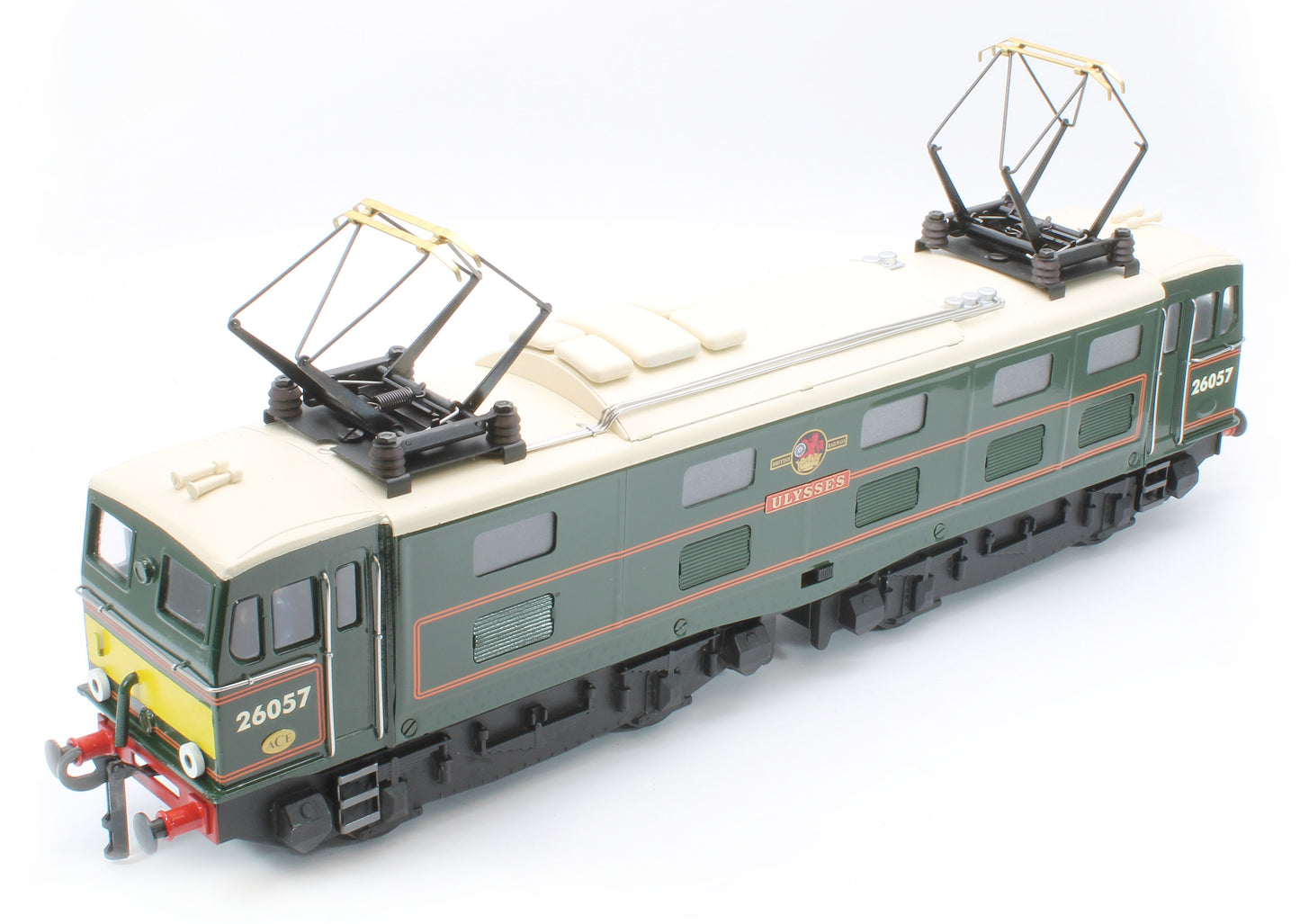
Ace Trains E/49-B4 "EM1" BR Class 76 "Ulysses" (Post 1956) Lined Gloss Green with Small Yellow Ends No.26057 Electric Locomotive


Product Details
| SKU | ACE-E/49-B4-U |
|---|---|
| Vendor | Ace Trains |
| Categories | Ace Trains Best selling products Diesel Locomotives In stock Items Latest Releases Locomotives New products O Gauge Diesel Locomotives O Gauge Latest Releases O Gauge Locomotives O Gauge scale |
| Scale | O Gauge |
| Share | |
| Features |
|
Product Description
Box Specification:
- All metal construction
- Precision engineered
- Individually tested by ACE Trains
- 2 Rail or 3 Rail Running (Switchable)
- Operates on 0-20V DC
- Will run on radii down to 2ft
- Operating directional cab lights
- Operating directional marker lights
- Sprung Buffers
About ACE Trains
ACE Trains have established their products as the most desirable and collectable O gauge model trains available today – faithful to time honoured traditions of craftsmanship and attention to detail, which were established in the Victorian and Edwardian eras.
History
The prototype, LNER No. 6701, was completed at Doncaster Works in 1941 to a design by Sir Nigel Gresley, but electrification of the Manchester Sheffield route for what it was intended, together with construction of five similar locos, was delayed by WW2.
In 1947, by this time numbered 6000, it was loaned to Dutch Railways to help with their post-war shortage of locomotives.
While in the Netherlands, it gained the name 'Tommy' after the nickname given to British soldiers during WW 2
When it was returned to the UK in 1952 it was officially named 'Tommy', with a commemorative nameplate and ran for the rest of its working life with that nameplate. The LNER assigned it the classification EM1.
It was re-numbered 26000 following the formation of British Railways in 1948.
Between 1950 and 1953, a further 57 locomotives were built at Gorton locomotive works, Manchester to the same design; these were also classified as Class 76, under the TOPS classification scheme introduced on 28 March 1968, and were fitted with twin diamond-shaped pantographs. At certain points on the Woodhead Line, notably in the vicinity of steam locomotive water-columns, the electric overhead lines were as high as 20 feet above the tracks. The pantographs had to stretch to almost their full height to reach the wires at some points, as well as collecting current from side contact collection under any weather condition. The first section of the Manchester to Sheffield Woodhead route, between Dunford Bridge and Wath, was not electrified until 4 February 1952. The lines between London Liverpool Street and Shenfield had already been electrified in September 1949, using the same 1500 V DC system. In 1950, the first ten locomotives built were sent to Ilford depot in Essex for trials.