
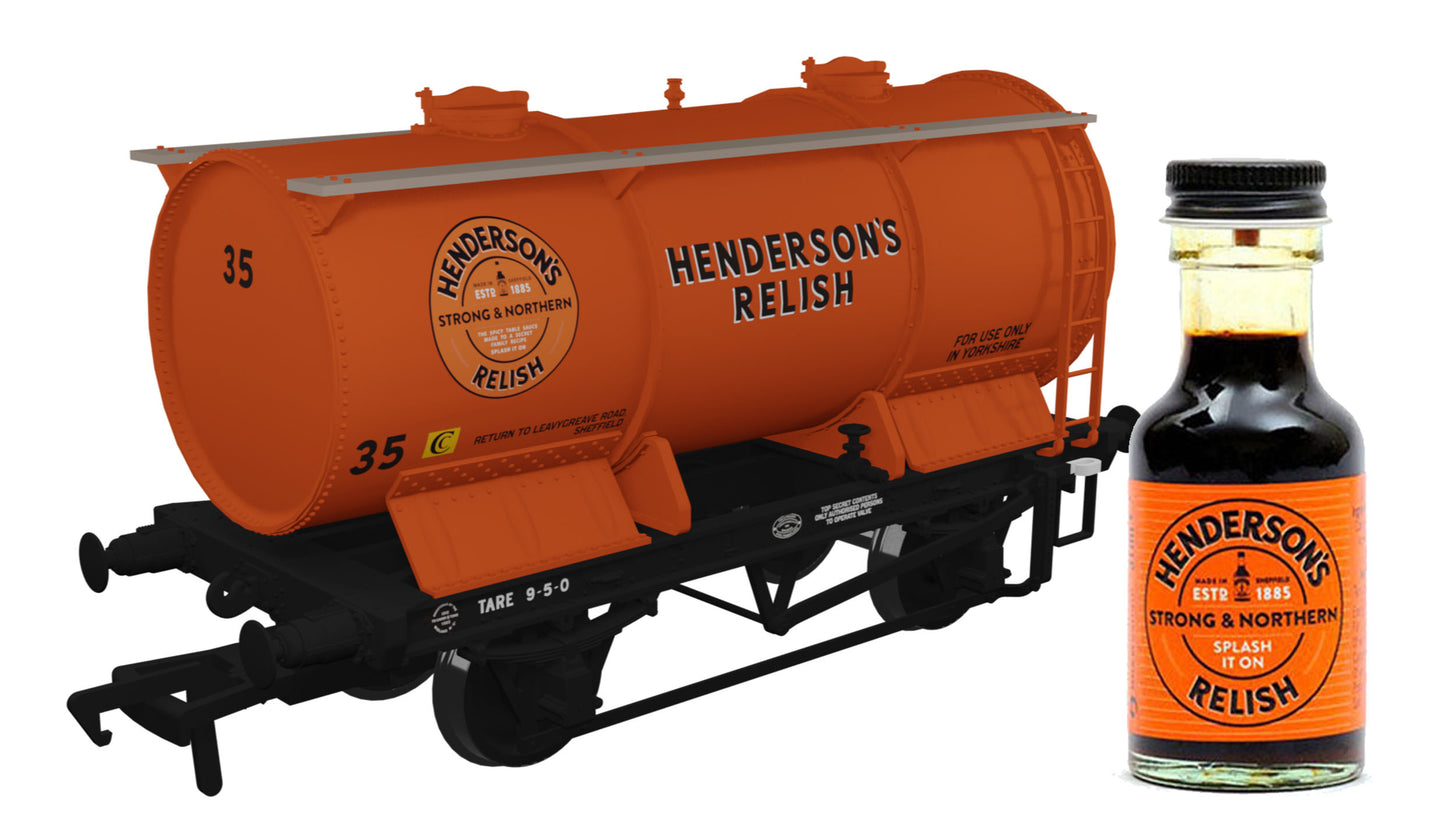
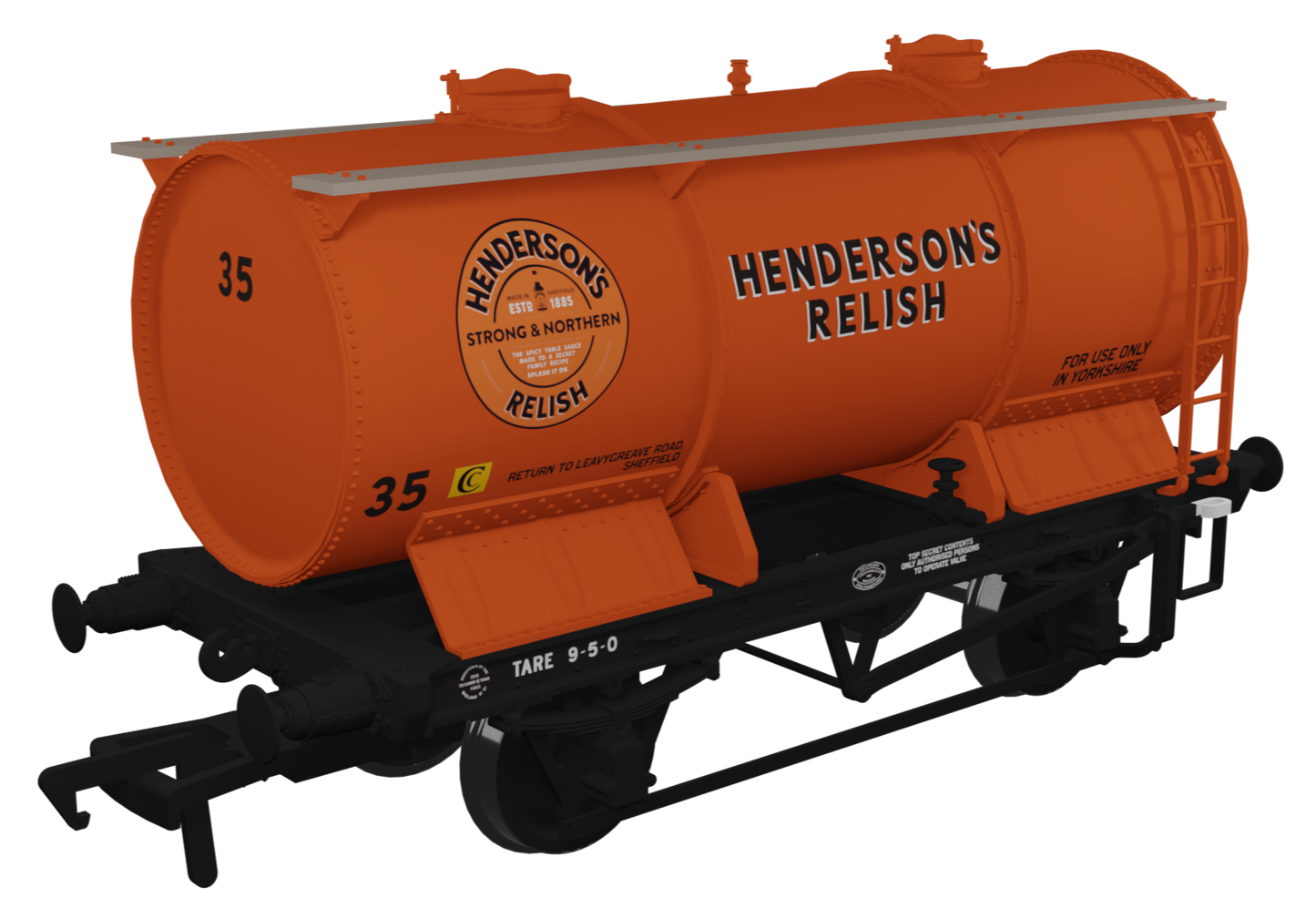
Rapido Trains UK 981014 Ammonium Nitrate Wagon - NSFF Henderson's Relish No.35


- Pre-Order


Product Details
| SKU | RAP-981014 |
|---|---|
| Vendor | Rapido Trains UK |
| Categories | Best selling products Exclusive to Rails HO-OO New products NSFF Ammonium Nitrate / Chemical Tank OO Gauge Rolling Stock OO Gauge scale OO Gauge Wagons & Freight Pre-Orders Rapido Trains UK Rolling Stock Wagons & Freight |
| Scale | OO Gauge |
| Share | |
| Features |
Product Description
Exclusive to Rails!
Expected Delivery Q3 2026 (Subject to Change at Manufacturer's Discretion).
A true Sheffield delicacy.
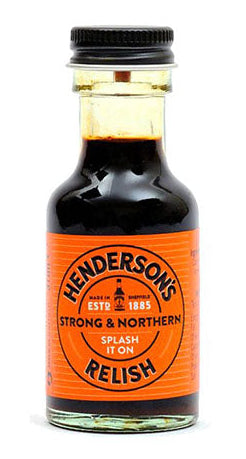
Complete with pocket sized 31ml Henderson's Relish bottle.
Henry Henderson blended the first batch of this famous Relish in Sheffield in 1885. More than 130 years later, Henderson's are still a family business, and still blending in Sheffield to a secret recipe, known to only three family members.
Use as a table sauce and ingredient, splash on top of your dinner or add it to the pot while cooking. Suitable for vegetarians and vegans, is gluten free and has no allergens.
OVER ONE MILLION BOTTLES SOLD, ENOUGH RELISH FOR EVERY MAN, WOMAN AND CHILD IN SHEFFIELD TO HAVE OVER HALF A PINT EACH!
Matt Helders, Arctic Monkeys: LIKE WORCESTER SAUCE, BUT ONE MILLION TIMES BETTER!
- Ammonium Nitrate Wagon
- NSFF Henderson's Relish No.35
- Underframe discharge pipe
- Disc wheels running in metal bearings
- High level of detail above and below the floor line
- High quality livery application
- NEM coupler pockets
- 1:76 scale, (OO gauge)
- UK designed
The Great War brought about the industrialisation of warfare and alongside it, technological developments such as aeroplanes and tanks.
At this time, there was also an enormous change in the manufacture of munitions. In the UK, this was brought about by the Ministry of Munitions. From 1915, they took charge of the entire process of manufacturing armaments, which included the acquisition of the raw materials right through to the production of the finished artillery shells.
One of the Ministry’s greatest accomplishments was to set up a network of National Shell Filling Factories (NSFF), which packed the explosives into shell casings. Foremost amongst these was NSFF Chilwell, near Nottingham. By the end of its production in 1918, NSFF Chilwell had produced more than 19 million shells and employed over 8,000 workers.
The explosive packed into the shells by Chilwell and other factories was a mixture of TNT and ammonium nitrate called ‘amatol’, which was produced by mechanically mixing the two components and squeezing them into the shell casing; the ammonium nitrate and TNT they used was produced at other sites and transported by rail to Chilwell. Needless to say, this process was very hazardous, and on 1st July 1918 an accident occurred. This enormous explosion resulted in the deaths of 138 workers, with a further 250 injured.
In the latter part of the Great War, the Ministry of Munitions commissioned a new ammonium nitrate factory to be built at Swindon, which would facilitate the bulk transport of the chemical between Swindon and Chilwell. To accommodate the safe transfer of this volatile load, the Ministry ordered a fleet of 100 10-ton tank wagons from The Leeds Forge Company in 1916.
Ammonium nitrate is a tricky chemical to transport because it is a crystalline substance which absorbs water vapour and then sets hard like concrete, so there is potential for the load to set hard during transportation. To counter this problem, the wagon’s design featured an airtight tank to prevent water ingress. This door resembled a conventional dished tank barrel end and was designed to open like a smokebox door, with a hinge at the top.
The wagons were loaded through the two manholes on the top of the barrel and were emptied at Chilwell by releasing the end door and lifting them at the fixed end of the wagon to tip out the contents, which was further aided by the conical shape of the barrels. These were highly unusual wagons, as they appeared to be similar to their conventional liquid tank wagon counterparts but instead carried powder. They also featured underframes made from pressed steel components, which was a speciality of The Leeds Forge Company.
At the end of WW1, these wagons immediately became War Surplus and were disposed of as there was no need for any wagons to transport ammonium nitrate. They were subsequently converted into liquid-carrying tank wagons. This was done by securing the end door and fitting discharge facilities.
As almost brand-new wagons, they quickly found homes with several private companies. With these gradually changing hands over the years, they would appear across the country in an eclectic mix of guises.
No longer limited to ammonium nitrate, they were utilised by organisations such as the British Molasses Co., Derby Gas Company, Glasgow Corporation Chemical Works, British Sugar Corporation and the War Department, which sent them to the Longmoor Military Railway.
Another of these new owners was Chipman Chemicals. Tasked with weedkilling, Chipman’s created purpose-built trains that featured tank wagons filled with a chemical weedkilling solution. This was then sprayed as the train moved. Weedkilling trains featuring these vehicles were seen from the grouping era through to the 1960s. Tank wagons were generally long-lived vehicles, and the Leeds Forge tanks were no different. Many lasted in service into the early 1960s, surviving into the early modernisation era; two complete examples are now preserved at the Middleton Railway and the Leeds Industrial Museum.
These explosive new models are our first-ever tank wagon; they will have the usual wealth of full external and underframe detail and feature numerous tooling variants. There are 13 different versions for you to choose from.
Detail differences within the range include split or continuous walkways, hinged end-door or fixed-ended tanks, and a selection of top, side and end valve setups depending on the version.